Europe is the largest and most demanding destination for Egyptian herbs and spices. It is demanding in a specific and navigable way: the requirements are written down, enforced at the border, and applied consistently. For an exporter or importer who takes documentation seriously, that predictability is an advantage. This is an orientation to what European buyers are asking for and why.
What European buyers are actually asking for
Across categories, the recurring themes in European enquiries are consistent:
- Traceability to a defined level. Not just "Egyptian origin" but identification of the lot and the ability to trace it back through processing.
- Residue compliance against the EU framework specifically, evidenced by analysis rather than asserted.
- Documented food safety management at the processing facility, increasingly under a GFSI-recognised scheme where the buyer supplies a retailer.
- Consistency between deliveries, because European manufacturers are formulating to a fixed recipe.
- Responsible sourcing information, as due-diligence expectations extend up the supply chain.
Note what is not on the list: the lowest price. European buyers are price-sensitive, but a failed consignment costs more than the price difference, so demonstrable compliance tends to win the account.
Clean label, and why it favours these products
The move away from synthetic additives towards recognisable ingredients works directly in favour of botanical raw materials. Herbal infusions replace flavoured products; natural colour sources such as hibiscus and paprika replace synthetic colours; spices and herbs carry flavour where a synthetic flavouring previously did.
This raises the technical bar rather than lowering it. When a botanical is doing the work an additive used to do, the manufacturer needs it to perform to a consistent, measurable standard — a colour strength, a volatile oil content — which is why European specifications increasingly name parameters that used to be informational.
The regulatory framework, in outline
Four areas govern most consignments:
- Pesticide residues. The EU sets maximum residue levels per active substance and commodity, and they are revised. A compliance claim must name the framework and the date. Screening should be run against the EU panel specifically, not against a generic international panel.
- Contaminants. Limits exist for mycotoxins, heavy metals and certain process contaminants, again by commodity.
- Official controls at the border. Certain products and origins are subject to increased checks, and the lists are periodically revised. Your importer should confirm the current position for your commodity before shipment.
- Food information and labelling. Rules govern what must appear and in what form for the material's stage in the chain.
The practical instruction that follows is simple and important: write the framework into the contract. "EU compliant" without naming what is being complied with, and as at when, is not a term either party can test.
Why Egyptian origin fits the European requirement
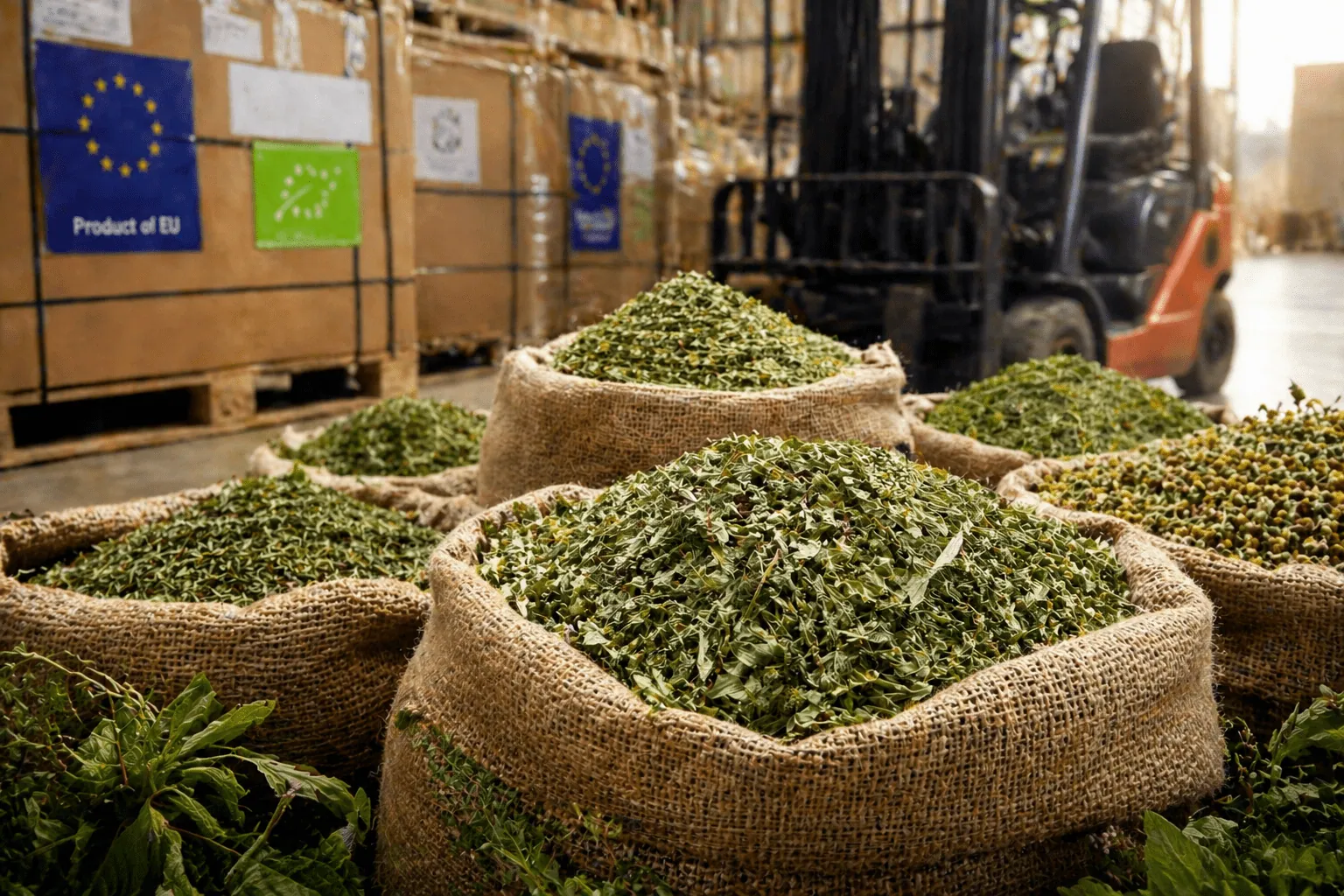
Beyond product characteristics, the structural fit is about logistics and documentation. Short sea transit from Alexandria to European ports means less time in which volatile oils dissipate and colour degrades, and it means shorter lead times for a manufacturer running lean inventory. A chain with fewer intermediaries between the field and the vessel is also a chain in which traceability is easier to maintain — which is what a European due-diligence questionnaire is really probing.
The reasons Egyptian growing conditions suit these crops are set out in the Egyptian advantage.
What an exporter has to do to serve this market
Honestly stated, serving European buyers well requires:
- Testing against the destination's framework, per lot, from a competent laboratory
- Traceability maintained through aggregation and processing, not reconstructed afterwards
- A food safety management system that survives an audit, not just a certificate on a wall
- Documentation that is internally consistent and arrives before the vessel
- Willingness to contract to specified parameters rather than to typical values
Guidance for European buyers sourcing from Egypt
- Name the regulatory framework and the applicable date in the contract.
- Require lot-specific analysis, and state the sampling basis.
- Verify the food safety certificate's scope covers the facility that will process your goods.
- Ask how far back a lot can be traced, and how quickly.
- Agree remedies for out-of-tolerance results before the first shipment, not after.
- Confirm current border-control status for your commodity with your broker.
Our export documents page sets out the standard set we issue, and our B2B sourcing guide covers the contracting process. To discuss a European requirement, contact our export team.